

The Ranch that Became ‘Camp Rebel’
The Ranch that Became ‘Camp Rebel’
Dr. Kathryn Kotrla, a retired psychiatrist, stepped out of her home on July 5, 2025, to see her ranchland had flooded.
“I wasn’t too alarmed; the ranch has flooded before,” Kotrla notes. “But I didn’t know yet that lives had been lost, and homes had been washed away down the creek. The next day, county crews showed up doing search and recovery, and they found the first body out here. Then the next day, a wonderful man named J.J. rode in on a utility vehicle and asked whether he might look for his daughter’s body? Well, there’s no answer to that except ‘Yes. Of course.’”
The historically destructive and deadly flooding that happened in Central Texas over the July 4, 2025, weekend hit Kerr County the hardest. But Travis County also suffered deeply, with ten lives lost, destroyed homes and damaged infrastructure, and widespread resident displacement. The area around Sandy Creek was particularly impacted.
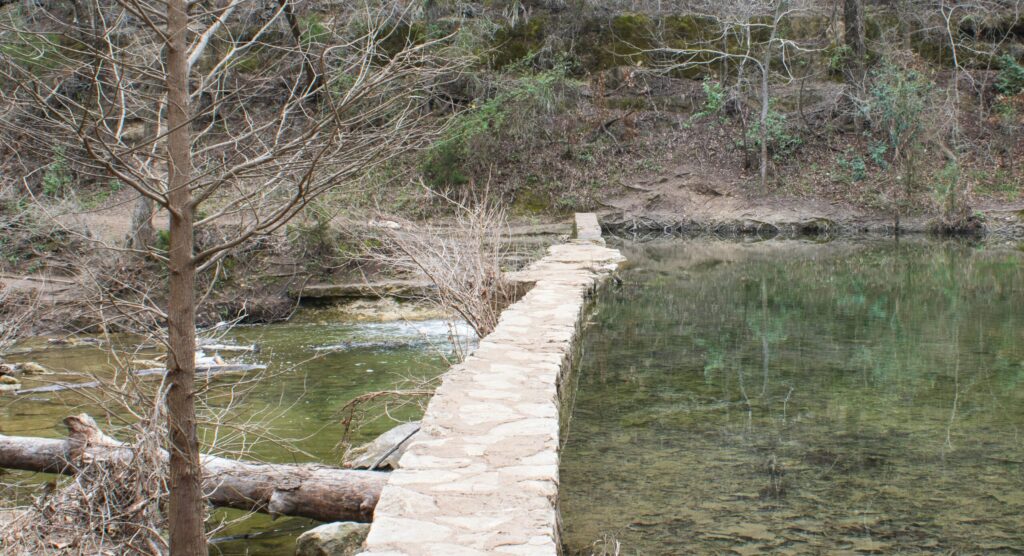
The Flying K Ranch is an 800-acre property that includes access to Sandy Creek, along with beautiful rolling hills, huge old oaks, a main house, a guest house, and a storage barn. Kotrla and her now-late husband, Robert Morris, moved to the ranch in 2013, when she inherited it from her Aunt Martha. Braun & Gresham worked with the couple to put half of the ranch under a conservation easement, preserving it in perpetuity.
As a family, we feel a real sense of responsibility to this land,” recalls Kotrla. “It’s so special to me. I’ve been coming out here since I was in a bassinet, it’s where I grew up, it was a refuge, and it’s always brought me such solace. My aunt didn’t have kids, and we were very close. I became her caregiver, and when she died, she left the whole property to me, which I never knew she was going to do. It’s a great blessing.”
Flying K Ranch Manager Robert Lee had been out of town during the holiday weekend, but had checked in with Kotrla, who told him she was safe but there was “a lot of water.” Lee says he wasn’t prepared for what he saw when he returned to the property midweek.
“When I walked down to the creek, I was like, ‘This isn’t a lot of water; this is all the water,’” Lee remembers. “I was checking it out, and saw seven dudes wearing orange vests walking the creek. They were volunteers, searching for bodies. They were clearly dehydrated, so I brought them back up to the house, got them some water, and drove them home. When I got back to the ranch, there was a young woman who wanted to check a few spots for a hit they’d gotten via remote viewer. She was running the Windy Valley recovery effort, which was all volunteers, too.”
Lee recognized the need for a volunteer coordination effort to search and clear Sandy Creek. He called Kotrla and told her there were many people still missing, and he wanted to use the ranch as a staging area for search and recovery; she told him to do whatever was necessary to find those people.
From Flying K to Camp Rebel
Lee got connected with a local disaster-relief dispatcher, who coordinated with volunteer search-and-rescue organizations to let them know about Flying K. Within just a few days, hundreds of volunteers – including members of Team 409 (southeast Texas), the United Cajun Navy (Louisiana), HALO Relief (Georgia), and the Mission Mules (North Carolina) – along with skid steers, giant excavators, mini-excavators, fuel trucks, mechanics, medics, and food trucks from several other states appeared.
“On day one, my wife’s employer, Tex-Mix Concrete, sent their senior vice president and her husband over to help with a company credit card,” says Lee. “We needed chainsaws and other smaller equipment and supplies. I gave them a list, and they went and bought everything. He’s a former naval officer, so he also helped organize our teams. A crew would be a skid steer, an excavator, and 18 people, including two chainsaw guys, two spotters, and a safety guy. We had about 20 of those working every day. So we ran for 16 days, about 350 to 400 people, about $7 million worth of equipment, thousands of gallons of fuel, over 1,000 meals a day, all volunteer.”
Some government folks would come down in the mornings to check on us, but they didn’t bother us,” he continues. “One of the Texas Department of Public Safety lieutenants told me, ‘We’re calling y’all Camp Rebel, and we’re not telling any of the higher-ups what’s happening down here, because y’all are doing such a good job – we don’t want someone to come in and screw it up.’ We cleared 12.5 miles of Sandy Creek, from the ranch just north of us all the way to Lake Travis.”
A Respite Among the Wreckage
Using Dr. Kotrla’s guest house, barn structure, and an adjacent field – along with seven donated Porta Pottys – as the main staging area, Camp Rebel crews worked daily from morn til 5 p.m. Lee was insistent on a five o’clock shutdown to help prevent burnout.
“The ranch was such a great place to come back to at the end of the day,” effuses Lee. “The guesthouse has a big patio, a screen porch, and a large dining table, and it’s right next to the creek. It wasn’t a tent in the middle of a field with generators running and bright lights. It was like coming home for these guys who were working their asses off all day, every day. They could get some dinner, have a beer, and go home for the night, shower, and come back the next morning ready for the day. It was really peaceful.”
Meanwhile, Dr. Kotrla put her decades of professional experience to work. Kotrla specialized in the neuroscience of trauma and recovery, worked extensively with combat veterans, and eventually became the founding Dean at the Texas A&M Health Science Center – Round Rock campus. Even in retirement, she has offered Flying K as a place of healing, hosting yoga trainings and other wellness retreats on the property.
“I mindfully checked in with the crews in the morning and in the evening,” Kotrla attests. “These people were exhausted and traumatized. I wanted to give them a sense of ‘Everything’s fine. You’re welcome here. I see you, and I appreciate what you’re doing.’ Just help create an atmosphere of folks feeling safe to do the work they were doing, that’s all I was doing.”
“Whatever you were trying to do there,” asserts Lee, “you did it perfectly. Your presence made a huge difference. Every single person loved it here.”
A Remarkable Refuge
Two flood survivors and two victims were found at Flying K Ranch. But for 16 days in a heartbreaking Texas summer, hundreds of courageous volunteers from around the country found much more there: a little relief, a lot of community, and – just like Kathryn Kotrla did as a child – a welcoming refuge, a port still sorely needed after a crushing storm.
It was like God put all the right people in all the right places at the right time,” Lee concludes. “It was a lot of hard, hard work, and it was seriously stressful, but it worked. It worked without a hiccup. Nobody got dehydrated, nobody got hurt, when equipment broke down, we had a mechanic who fixed it. I don’t want to do it again, no. But for a time, it was awesome to be a part of.”